

Most B2B sales teams are sitting on a slow budget drain they never talk about openly: the cost of prospecting the wrong people. When your outreach list isn't properly segmented, you're burning rep time, ad spend, and email deliverability on contacts who were never a real fit. Research confirms that smarter segmentation directly lifts revenue growth, yet most SMBs still default to broad industry lists and hope for the best. This guide walks you through a structured, step-by-step approach to business list segmentation, from auditing your data to automating workflows, so you stop leaking pipeline and start generating leads that actually convert.
- Preparation: Lay the foundation with a data and ICP audit
- Step-by-step: Layer segmentation dimensions for precision
- Automation, workflows, and real-world troubleshooting
- What most B2B teams overlook about segmentation
- Ready to power up your segmented business lists?
- Frequently asked questions
Key Takeaways
| Point | Details |
|---|---|
| Start with clean data | A structured segmentation process begins with up-to-date, accurate business contact data. |
| Layer segmentation types | Combining firmographic, behavioral, technographic, and psychographic data delivers higher-quality leads. |
| Operationalize with automation | Automating segmentation and workflows keeps your lists dynamic and actionable. |
| Prioritize ongoing optimization | Frequent review and adaptation are key for maintaining segmentation ROI as markets shift. |
Why segmentation strategy matters in B2B lead generation
After illustrating the core challenge, let's explore why segmentation is so crucial for B2B results.
Segmentation is not just a marketing buzzword. It's the difference between a campaign that fills your pipeline and one that fills your spam complaints folder. When your list is broken into meaningful groups based on shared characteristics, your messaging becomes relevant. Relevant messaging gets opened, clicked, and acted on. Generic messaging gets deleted.
Here's what the numbers say. Industry segmentation can double revenue growth rates compared to broad, general segmentation approaches. That's not a marginal improvement. That's the kind of lift that changes quarterly forecasts and justifies your marketing budget to leadership.
The gap between basic and advanced segmentation
Most teams do basic firmographic segmentation: they filter by industry, company size, and geography, then call it a day. That's a fine starting point, but it leaves enormous opportunity on the table. Two companies in the same industry with the same headcount can have completely different buying motivations, tech stacks, and pain points.

The table below shows how segmentation sophistication impacts key performance indicators:
| Segmentation type | Avg. email open rate | Lead quality score | Sales cycle length |
|---|---|---|---|
| No segmentation | 12-15% | Low | Longest |
| Basic firmographic | 18-22% | Medium | Moderate |
| Multi-dimensional (layered) | 28-35% | High | Shortest |
The performance gap is real and measurable. Advanced segmentation also makes segmentation in local business marketing more effective because you can tailor offers to hyperlocal context, not just geography.
What poor segmentation actually costs you
When segmentation is weak, you see specific, painful symptoms:
- High unsubscribe rates because contacts receive irrelevant messaging
- Low sales productivity as reps waste time on poorly qualified leads
- Deliverability issues when email engagement metrics tank your sender reputation
- Missed revenue from high-value segments that weren't properly targeted
- Budget inefficiency as ad spend gets distributed across too wide an audience
Think about what happens when a mid-market software vendor blasts the same cold email to a 500-person enterprise, a 10-person startup, and a 200-person regional manufacturer. None of those three companies have the same budget, decision-making structure, or urgency. The message lands flat for all three.
The upside of getting segmentation right
Done well, layered segmentation delivers measurable benefits across the entire revenue funnel. Sales reps spend more time on conversations with qualified buyers. Marketing sees better engagement metrics. And leadership sees shorter sales cycles and higher close rates. You can also explore industry-based email lists as a starting structure, then layer additional dimensions on top for precision targeting.
The bottom line: segmentation is an operational investment, not a one-time task. The teams that treat it that way consistently outperform the ones still working from undifferentiated prospect dumps.
Preparation: Lay the foundation with a data and ICP audit
With the value of segmentation clear, the next step is building a strong data foundation.
You can have the most sophisticated segmentation model in the world, but if your underlying data is stale, duplicate-ridden, or incomplete, the whole system breaks down. Garbage in, garbage out. Before you start slicing lists, you need to know what you're working with and who you're actually trying to reach.
As a practical starting point, start with a data audit and a clear Ideal Customer Profile (ICP) definition before any segmentation work begins. This is foundational, not optional.
Defining your ICP
Your ICP is the detailed description of the company and contact who would get the most value from your product or service, buy fastest, and stay longest. Defining your ICP involves analyzing your existing best customers and asking:
1. What industry are they in?
2. What is their company size (revenue and headcount)?
3. What geography do they operate in?
4. What tech stack do they use?
5. What pain points drove them to buy?
6. Who was the decision-maker, and what was their role?
Once you answer those questions across your top 20 to 30 customers, patterns emerge. Those patterns become your ICP, and your ICP becomes the filter through which every segmentation decision gets made.
Static vs. dynamic list segmentation: A comparison
One of the most consequential decisions in your segmentation setup is whether you use static or dynamic lists. Here's how they differ:
| Factor | Static list | Dynamic list |
|---|---|---|
| Update frequency | Manual, periodic | Automatic, real-time |
| Accuracy over time | Degrades quickly | Stays current |
| Effort to maintain | High | Low (after setup) |
| Best use case | One-time campaigns | Ongoing nurture sequences |
| CRM support | Basic | HubSpot, Salesforce, others |
Static lists work for short-term campaigns where the audience is fixed. Dynamic lists are the standard for any serious, ongoing segmentation effort. They update automatically when a contact meets or no longer meets your criteria.
Essential data sources to pull from
For a solid segmentation foundation, you need data from multiple sources:
1. CRM records: Your existing customer and prospect data, including engagement history and deal stage
2. Marketing automation platforms: Behavioral data like email opens, clicks, and form fills
3. Website analytics: Pages visited, time on site, and content consumed
4. Third-party enrichment tools: Firmographic and technographic data appended to existing records
5. Intent data feeds: Signals from buyers actively researching topics related to your solution
You can find practical prospecting list Excel and CRM import guidance to help structure this process. The goal is to build a unified view of each prospect before you start assigning them to segments.
Pro Tip: Run deduplication checks in your CRM before any segmentation exercise. Duplicate records create skewed data that leads to double-outreach, inflated segment sizes, and inaccurate performance reporting. Most CRMs have built-in deduplification tools. Use them.
Step-by-step: Layer segmentation dimensions for precision
After building the foundation, now layer sophistication through advanced segmentation dimensions.
Segmentation isn't a single filter. It's a stack of filters, each one adding more precision to your targeting. The most effective B2B segmentation strategies layer multiple data types together to create tight, high-intent audience groups.
Firmographics are foundational, but behavioral and psychographic data drive the strongest results. And layering multiple data types, including technographic signals, measurably improves lead quality.
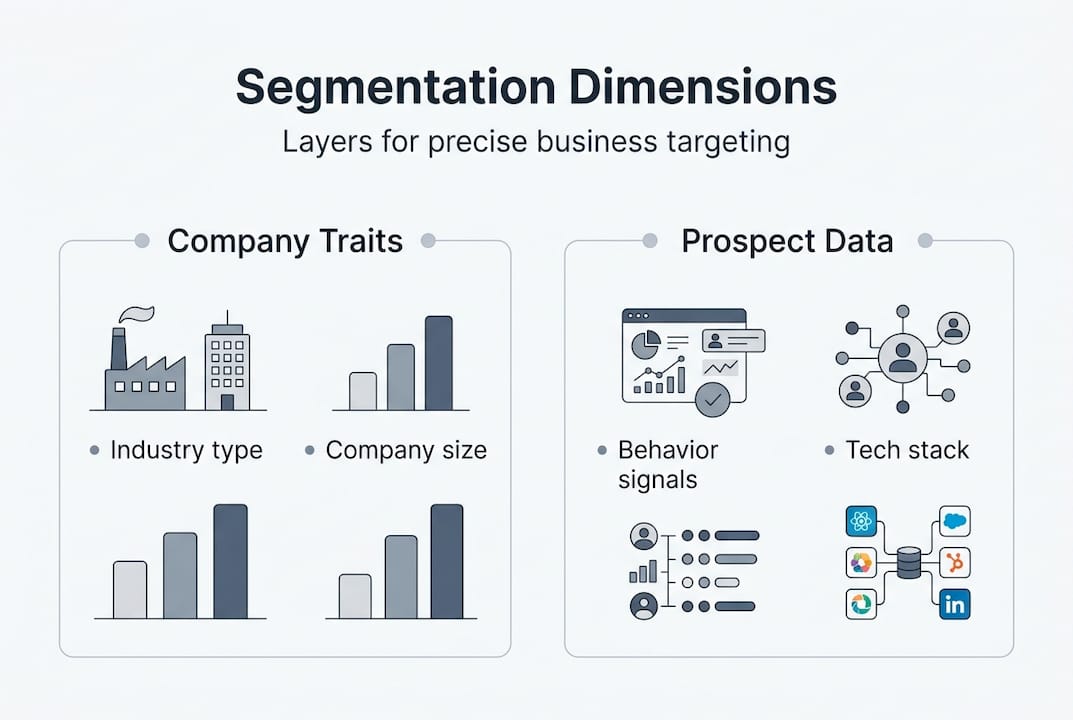
Here's how to build your segmentation stack step by step:
The four segmentation dimensions
1. Firmographic segmentation
This is your starting layer. Group companies by industry vertical, employee count, annual revenue, and geographic location. It's easy to execute and widely supported by any modern CRM. The limitation is that two companies can look identical firmographically but behave very differently.
2. Behavioral segmentation
This layer tracks what prospects actually do: emails opened, content downloaded, webinar attendance, product page visits, demo requests. Behavioral signals tell you where someone is in the buying journey far better than any static attribute.
3. Technographic segmentation
This layer maps the technology stack a prospect company currently uses. If you sell a tool that integrates with Salesforce, technographic data lets you target only companies already using Salesforce. That's a completely different conversation than cold outreach to a company on a legacy system.
4. Psychographic segmentation
This is the most overlooked layer. Psychographics capture buyer motivations, values, risk tolerance, and organizational culture. A company that values innovation moves differently than one that values stability. Your messaging needs to reflect that distinction.
The layering process
1. Start with firmographics to define your universe of eligible companies
2. Apply ICP filters to narrow to best-fit company profiles
3. Overlay behavioral data to identify active buyers vs. cold prospects
4. Add technographic filters where product fit or integration compatibility matters
5. Incorporate psychographic signals (via content consumption patterns, survey data, or intent data) to refine message angle
6. Score and rank segments by estimated revenue potential using lead scoring with implicit and explicit data
Behavior-based triggers are the single most reliable indicator of near-term purchase intent. A prospect who downloads your pricing guide and visits your case study page twice in one week is telling you something your firmographic filter never could.
Platforms like HubSpot and Salesforce support dynamic list creation based on behavioral triggers. You can also explore how AI in segmentation workflows is making this layering process faster and more automated.
Pro Tip: After building your segments, rank them by estimated deal size and conversion probability. Focus your highest-effort outreach (like direct mail or personal video) on Tier 1 segments, and use automated sequences for Tier 2 and Tier 3.
Automation, workflows, and real-world troubleshooting
Once segmentation is defined, executing with automation maximizes outcomes, but it's crucial to anticipate real-world challenges.
Defining your segments is only half the job. The other half is building systems that put those segments to work without requiring constant manual intervention. CRM-based automation, including workflows, territory routing, and deduplication, is essential for operationalizing dynamic segmentation at scale.
How to set up automation for segmentation
The core components of a segmentation-driven automation system include:
- Enrollment triggers: Rules that add contacts to a segment when they meet specific criteria (e.g., visited pricing page, downloaded whitepaper, reached a lead score threshold)
- Workflow sequences: Automated email sequences tailored to each segment's messaging and offer
- Territory routing: Logic that assigns leads to the right sales rep based on geography, industry, or account size
- Lead scoring updates: Real-time score adjustments as prospects engage or go dark
You can explore B2B email marketing workflow examples to see how these components fit together in practice. The goal is a system that surfaces the right lead, to the right rep, with the right message, at the right time.
Common segmentation mistakes and how to fix them
Even well-intentioned teams run into execution problems. Here's a troubleshooting table for the most frequent issues:
| Problem | Root cause | Fix |
|---|---|---|
| Segments too broad, low engagement | Relying only on firmographics | Add behavioral and intent filters |
| Lists becoming stale fast | Using static lists | Switch to dynamic, CRM-based lists |
| Wrong reps receiving leads | Missing territory routing logic | Build routing workflows in CRM |
| Duplicate outreach to same contact | Poor deduplication practices | Run dedup checks before campaigns |
| High unsubscribes from nurture sequences | Messaging not matching segment needs | Revisit ICP alignment and copy |
You should also look at website-driven email list building as a supplemental strategy. Capturing intent signals directly from your own site gives you first-party data that's often cleaner and more actionable than purchased lists alone.
The biggest mistakes B2B teams make
Beyond the table above, watch out for these recurring pitfalls:
- Over-relying on static lists that haven't been refreshed in six-plus months
- Ignoring engagement decay signals, like contacts who stop opening emails
- Skipping A/B testing within segments, which leaves optimization insights on the table
- Building too many micro-segments that are too small to generate statistically meaningful feedback
- Failing to close the loop between sales feedback and list criteria
Pro Tip: Set up a monthly segment review cadence. Check engagement rates, lead quality scores, and conversion rates for each active segment. If a segment's performance is declining, investigate whether the underlying data criteria still reflect your ICP, or whether the market has shifted.
What most B2B teams overlook about segmentation
Here's something we see consistently: teams invest real effort in building their initial segmentation model, see early gains, and then stop. They treat it as a project with a finish line rather than an ongoing system. That's where the plateau happens.
The deeper issue is that most teams fixate on who to target (firmographics) and never get to why those buyers actually buy (psychographics and behavioral context). Knowing a company has 200 employees in SaaS tells you almost nothing about their urgency, their internal politics, or their appetite for change. Those factors determine whether a deal closes in 30 days or 300.
Dynamic and AI-assisted approaches consistently outperform static lists because they adapt as buyer behavior evolves. Static models assume the market is frozen. It never is.
The teams that win long-term aren't the ones with the biggest lists. They're the ones with the most accurate feedback loops between what happens in sales conversations and how their segments get updated.
Treat segmentation as a living system. Build in regular reviews, connect sales team feedback directly to list criteria, and invest in lead generation learning that keeps your model current. The compounding effect of continuous refinement is where the real ROI lives.
Ready to power up your segmented business lists?
With strategy in hand, you're now equipped to transform segmented lists into measurable business growth.
Knowing the framework is one thing. Having the right data to execute it is another. SphereScout.io gives you immediate access to over 30 million verified business contacts, searchable and filterable by industry, city, postal code, and more.
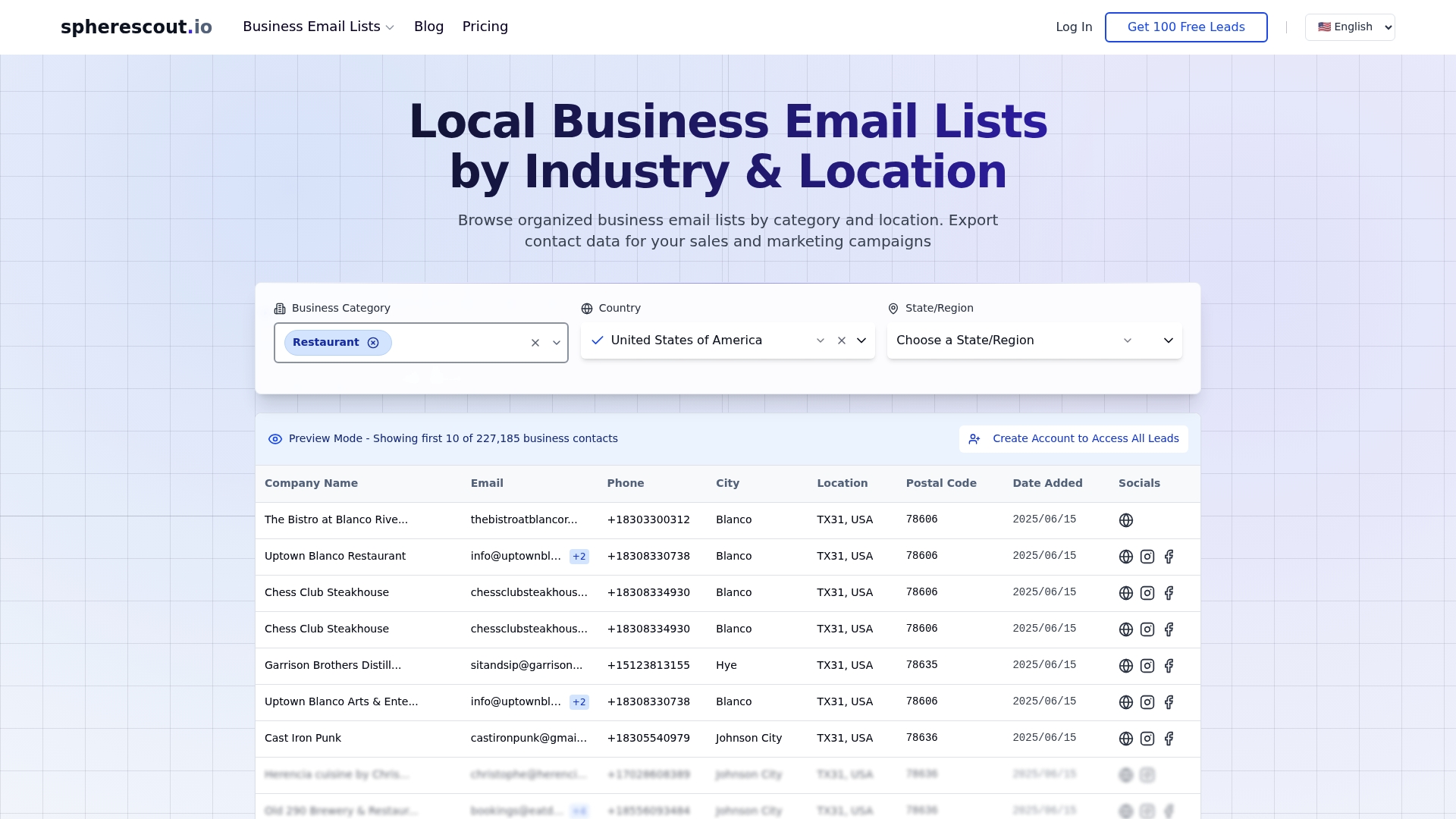
You can buy targeted business email lists built around your ICP criteria, then export directly to CSV for seamless CRM integration. If you're ready to go further, explore SphereScout's full suite of B2B lead generation functions to support ongoing segmentation, list refreshes, and outreach optimization. Start with a free sample to see the data quality firsthand.
Frequently asked questions
What is the difference between firmographic and behavioral segmentation?
Firmographic segmentation groups businesses by external traits like size or industry, while behavioral segmentation uses actual actions and engagement patterns to indicate buying intent. Firmographics are foundational but insufficient on their own because two identical-looking companies can behave very differently.
How often should I update my segmented lists?
Dynamic lists that auto-update via CRM provide the best results, but even manual lists should be reviewed at least quarterly to remove stale contacts and re-align criteria with your current ICP.
Which tools help with B2B list segmentation?
HubSpot and Salesforce are the most widely used platforms, offering dynamic list creation, AND/OR logic filters, behavioral workflow triggers, duplicate rules, and lead scoring to support full segmentation lifecycles.
What is the Ideal Customer Profile (ICP) and why is it important?
Your ICP defines the attributes of your best-fit customers, and starting with a clear ICP ensures your segmentation targets prospects most likely to convert quickly and generate the highest revenue value for your business.