

Most B2B sales and marketing teams spend significant resources building contact lists, then skip the one step that determines whether that investment pays off: verification. The assumption that data pulled from a database or exported from a CRM is "accurate enough" leads to real, measurable damage. Bounced emails erode sender reputation, calls to disconnected lines waste rep time, and misdirected outreach frustrates real buyers. This guide breaks down the true cost of bad contact data, explains how verification works step by step, and gives you actionable practices to protect and strengthen your lead generation results.
- How contact verification actually works
- Top challenges in verifying contact information
- Best practices for maintaining data quality
- Why "good enough" contact data is never enough: Our take
- Supercharge your lead generation with verified contacts
- Frequently asked questions
Key Takeaways
| Point | Details |
|---|---|
| Inaccurate data costs sales | Even a small percentage of wrong contacts can derail whole campaigns and waste resources. |
| Verification boosts response rates | Email and phone validation ensures more messages actually reach your intended prospects. |
| Manual and automated checks work best | Combining automation with periodic human oversight offers optimal lead quality. |
| Routine hygiene prevents decay | Scheduling regular verification and cleaning cycles keeps your lists highly effective. |
| Partner with reputable providers | Trustworthy vendors supply pre-verified data, reducing your verification workload and risk. |
The real cost of inaccurate contact information
Let's be direct: poor data is expensive. When you launch a campaign built on flawed contact records, you are not just losing a few leads. You are burning budget, hurting deliverability, and in some cases, signaling to prospects that your brand does not operate with care.
The types of bad data B2B teams encounter fall into a few predictable categories:
- Invalid or inactive emails: Addresses that no longer exist, were mistyped at collection, or belong to an employee who left the company.
- Disconnected phone numbers: Lines that were reassigned, canceled, or never properly formatted.
- Wrong titles or roles: Contacts listed as decision-makers who have changed positions or moved to entirely different organizations.
- Outdated company data: Companies that merged, rebranded, or shut down entirely.
Each of these errors creates a specific type of damage. Invalid emails inflate your bounce rate, which triggers spam filters and reduces inbox placement for future sends. Wrong phone numbers send sales reps into dead-end call attempts, reducing their efficiency and morale. And reaching out to the wrong person, especially repeatedly, signals to prospects that your organization does not do its homework. That reputational damage is harder to quantify but very real. Knowing lead generation risks like these upfront helps teams avoid costly mistakes before campaigns launch.
Industry insight: "Disconnected numbers, wrong line types, and VoIP fraud risk can eliminate contact opportunity entirely." Phone validation is not optional for serious outbound programs. A bad number yields exactly zero contact opportunities, no matter how compelling your pitch is.
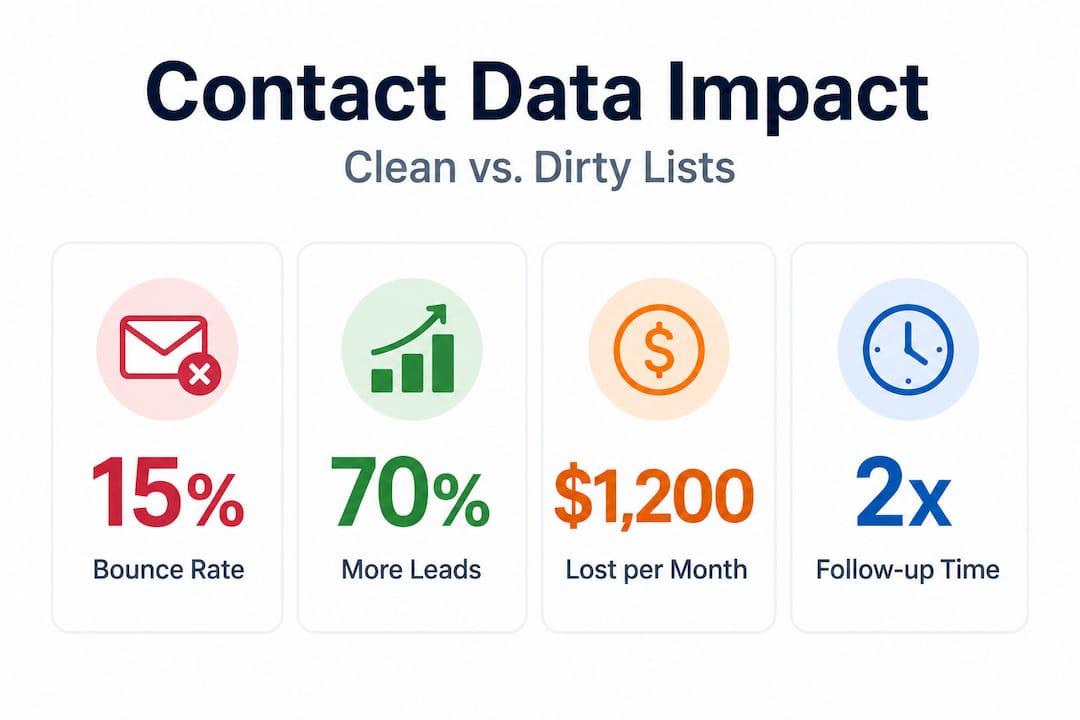
Here is a straightforward comparison showing how data quality directly affects campaign outcomes:
| Metric | High data integrity | Low data integrity |
|---|---|---|
| Email bounce rate | Under 2% | 15% or higher |
| Call connection rate | 35 to 50% | Under 10% |
| Deliverability (inbox rate) | 90%+ | 60% or lower |
| Cost per connected contact | Low | 3x to 5x higher |
| Sender reputation score | Maintained or improving | Declining |
The numbers tell a clear story. Teams operating with cleaner data do not just get better results. They spend less per result, and they protect the long-term health of their outbound channels. It is worth pausing here to internalize that: bad data does not just hurt this campaign. It compromises the next one too.
How contact verification actually works
Once you understand the stakes, the natural next question is: how does verification actually function? There is a logical sequence of checks, and understanding each step helps you evaluate tools and processes with more confidence.
Here are the core steps in a standard email and phone verification process:
1. Syntax check: The system confirms the email address is formatted correctly. This catches obvious typos like "firstname@companycom" or missing the "@" character entirely.
2. Domain and MX record lookup: The tool checks whether the domain actually exists and whether it has valid mail exchange (MX) records configured to receive email. A domain with no MX records cannot receive messages, so any email to that domain will bounce.
3. Real-time mailbox ping (SMTP verification): The system connects to the mail server and checks whether the specific mailbox exists, without actually sending an email. This identifies addresses where the domain is fine but the individual account does not exist or was deactivated.
4. Phone line type detection: For phone numbers, verification tools identify whether the number belongs to a mobile line, a landline, a fixed VoIP service, or a non-fixed VoIP service. Each category has different outreach implications.
5. Toll-free and fraud flag checks: Toll-free numbers are flagged because they are not valid for outbound dialing in most B2B contexts. VoIP lines, especially non-fixed ones, carry higher fraud risk and lower answer rates.
Understanding step four and five matters more than most teams realize. Differentiating line types and flagging invalid contacts directly improves how precisely your campaigns reach real buyers. A fixed VoIP line registered to a verified business address is generally acceptable for outreach. A non-fixed VoIP line, which can be generated cheaply and anonymously, is a much weaker signal and often connected to fraud or low-quality data.

Here is a practical comparison between manual and automated verification:
| Factor | Manual verification | Automated verification |
|---|---|---|
| Speed | Hours to days per batch | Seconds to minutes |
| Accuracy | Varies, human error prone | Consistently high for most checks |
| Cost | High (staff time) | Low per record at scale |
| Best for | High-value, complex accounts | Large list hygiene at scale |
| Limitations | Not scalable | May miss nuanced edge cases |
You can find trusted business email lists that already incorporate verification steps, which saves your team from running raw data through these checks manually. The smartest approach treats automated tools as the default and reserves human review for top-priority accounts.
Pro Tip: Even the most sophisticated automated verification tools have edge cases they miss. Reserve manual cross-checking for your top 10 to 15% of target accounts, especially enterprise prospects where one bad contact record could mean missing a six-figure deal.
Building authentic contact info strategies around verified data is not a luxury upgrade. It is the baseline your campaigns need to function at their intended level.
Top challenges in verifying contact information
Knowing what verification is and how it works is one thing. Executing it consistently is another. B2B teams face several real-world obstacles that make ongoing verification harder than it sounds on paper.
Data decay is faster than most people expect. Research consistently shows that B2B data degrades at a significant rate annually. People change jobs, get promoted, switch companies, or leave industries entirely. In fast-moving sectors like technology, finance, and healthcare, the turnover is even higher. A list that was accurate six months ago may already have 10 to 15% invalid records by the time you run your next campaign.
Source errors compound quickly. Errors enter your database from multiple directions:
- Webform submissions with typos or fake entries.
- Data purchased or scraped from sources with inconsistent formatting.
- CRM mismatches when two records are merged incorrectly.
- Manual entry errors made by sales reps in a hurry.
Each of these problems multiplies if left unchecked. One bad import can contaminate a clean list. Verification also matters for phone outreach because disconnected numbers, wrong line types, and VoIP fraud risk can eliminate contact opportunity entirely, and those risks compound as your database grows without hygiene routines.
International and special number formats create unique headaches. Phone numbers with international prefixes, extensions, or unusual local formatting can pass basic checks but still fail on delivery. Toll-free numbers present an especially common trap: they look like valid business contacts but are not appropriate for outbound calls. Teams using location-based contact verification tools that account for regional number formats are better positioned to catch these issues early.
📊 Statistic callout: Even a 5% bad data rate in a list of 10,000 contacts means 500 failed touchpoints per campaign. Multiply that across email, phone, and direct mail channels, and you are looking at thousands of wasted outreach attempts per quarter.
Here are the most common verification challenges B2B teams report:
- Keeping up with contact turnover in high-velocity industries.
- Identifying which tool is most reliable for your specific data types and regions.
- Budget allocation for verification tooling versus list building.
- Internal adoption of data quality standards across sales, marketing, and ops teams.
- Handling legacy data from years of accumulated, unverified CRM records.
Pro Tip: Build a verification sweep into your campaign calendar as a standing task. Schedule it after every large data import and at least two weeks before any major campaign launch. That gives you enough time to clean, re-source, or deprioritize flagged records.
Best practices for maintaining data quality
All the verification knowledge in the world only generates value if you operationalize it. Here is a practical framework for turning contact quality from a one-time check into a reliable, ongoing process.
Five-step workflow for an always-on verification pipeline:
1. Verify at intake. The moment a new contact enters your system, whether through a form submission, a list import, or a manual CRM entry, trigger a verification check. Do not let unvalidated data sit in your database, even temporarily.
2. Run quarterly full-list audits. Set a recurring calendar event for full database hygiene. Quarterly works for most B2B teams. If you operate in a high-turnover industry, consider running audits every six weeks instead.
3. Pre-campaign verification sweeps. Before any major outreach initiative, verify the specific segment you plan to contact. This protects your sender reputation and prevents wasted spend on the campaign in question.
4. Post-event data reconciliation. After trade shows, webinars, or other lead-generating events, the contacts collected are often messy. Run verification immediately before those records are added to your active database.
5. Validate all phone line types before calling sequences begin. Proper validation of all line types and avoidance of toll-free for outbound ensures maximized connection rates. Build this step into your SDR workflow, not as optional, but as a required gate before any call sequence is activated.
Beyond the workflow itself, several supporting practices make a meaningful difference:
- Train your team to spot bad data patterns. Sales reps who know what a non-fixed VoIP flag looks like, or who know to flag suspicious email domains before sending, become an organic quality filter.
- Document your data standards clearly. Create a one-page reference for your team covering what constitutes an acceptable contact record and what requires verification or removal.
- Partner with reliable data sources that apply verification before they deliver records to you. Paying slightly more for pre-vetted data often costs less than cleaning cheap, unverified lists yourself.
- Tag and track verification status in your CRM. Know which records have been verified, when, and by what method. This visibility helps you prioritize resources and avoid re-running checks unnecessarily.
The goal is to make data quality a built-in habit, not a crisis response. Teams that treat verification as an ongoing process consistently outperform those that verify reactively, usually only after a campaign underperforms.
Why "good enough" contact data is never enough: Our take
Here is our honest assessment after working with B2B teams across dozens of industries: the phrase "good enough" is the single most expensive phrase in your lead generation vocabulary.
We see it repeatedly. A marketing team builds a list of 5,000 contacts, accepts a verification pass rate of 80%, and figures the 20% gap is manageable. It is not. That 20% is not just dead weight. It is active damage. Those invalid emails inflate your bounce stats. Those bad phone numbers waste rep time. And those wrong-role contacts, especially the ones who get repeated outreach by mistake, sometimes escalate complaints that put your domain on blocklists.
The uncomfortable truth is that most B2B marketers dramatically underestimate how quickly small data quality gaps compound into major campaign failures. A single campaign with poor deliverability trains email providers to route your messages to spam for future sends. That is not a one-campaign problem. That is an infrastructure problem that takes months to repair.
We have also seen the opposite clearly. Teams working from real-world lead generation lessons and genuinely clean lists consistently get more conversations from smaller volumes of contacts. A list of 1,000 verified, well-targeted contacts frequently outperforms a list of 5,000 unverified ones. Every time.
The industry frames verification as a cost. We frame it as the foundational investment that makes all your other spending meaningful. If you are allocating budget to email platforms, CRM tools, SDR salaries, and content production, but skipping verification, you are building on a shaky foundation.
"If you wouldn't call every number on your list, why would you email them?"
That question should inform how you evaluate your data quality processes going forward. Verification is not something you do after a bad campaign. It is what prevents the bad campaign from happening.
Supercharge your lead generation with verified contacts
Clean data strategies only work when the underlying contacts are worth verifying in the first place. That is where SphereScout.io comes in.
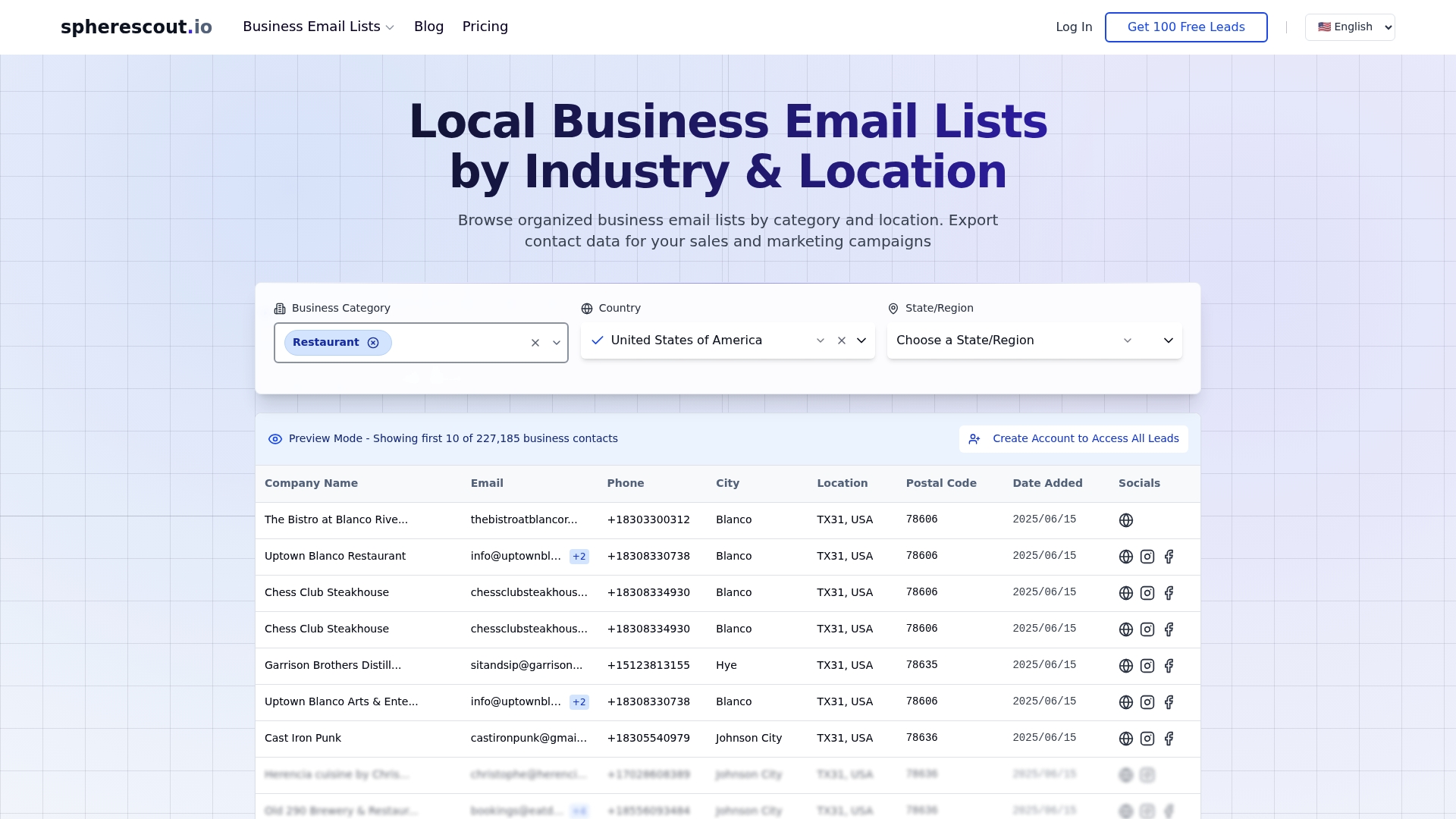
SphereScout gives B2B sales and marketing teams instant access to organized, filterable contact databases covering more than 30 million records across industries and regions. You can purchase verified business email lists segmented by industry, city, or postal code and download them as CRM-ready CSV files in minutes. If you want to go further, our automated lead generation solutions are built to help teams scale prospecting without sacrificing contact quality. Whether you are targeting a niche vertical or a broad regional market, SphereScout helps you start with the right contacts so your verification efforts actually have quality material to work with.
Frequently asked questions
How often should I verify my contact lists?
At minimum, verify contact lists quarterly or before every major campaign to maintain high accuracy. Teams in fast-moving industries should consider more frequent checks every six to eight weeks.
What's the risk of relying on VoIP or toll-free phone numbers?
VoIP fraud risk and connection issues make verification essential, as these number types often result in failed calls, wasted rep time, and potential exposure to fraudulent contact sources.
Does email verification matter if people rarely reply?
Definitely. Unverified emails harm your sender reputation and reduce inbox delivery rates, which affects every future campaign you send, not just the current one.
Can automated systems catch all bad contact entries?
Automated verification handles the vast majority of issues at speed and scale, but periodic manual review is still recommended for your highest-value prospects where edge cases could mean a missed opportunity.
What's the biggest cause of bad contact data in B2B?
Data decay is the leading culprit. Contacts change jobs or companies frequently, causing even recently verified lists to lose accuracy within months if not maintained consistently.
Recommended
- Blog | spherescout.io - B2B Lead Generation Insights
- Buy Email Database | Instant B2B Email Lists & Contacts
- Lead Generation for Buyer Types | spherescout.io
- Adressdaten kaufen nach Branche und Kategorie | SphereScout
- cold email lead generation
- email marketing vs cold email
- B2B email marketing process