

Most B2B sales teams are grinding hard while getting surprisingly little back. Cold email reply rates average just 1.9 to 3.4%, and good performance only starts at 4 to 6%. That means the majority of your outreach effort, your carefully crafted messages, your exported lists, your time, is landing in silence. For SMBs with lean teams and tighter budgets, that kind of waste hits differently. This article breaks down the specific, proven strategies that actually move the needle on reply rates, meetings booked, and pipeline quality without requiring an enterprise-sized team to pull off.
- Multi-channel is a must: Breaking email-only habits
- Mastering follow-up: Touchpoints, timing, and qualification
- Warming up leads: How to 2–3x your response rate
- Why most SMBs over-complicate B2B sales—and what actually works
- Get better leads and book more meetings with SphereScout
- Frequently asked questions
Key Takeaways
| Point | Details |
|---|---|
| Target quality over quantity | Focusing on fewer, well-defined ICP accounts leads to lower costs and more meetings for SMBs. |
| Use multi-channel outreach | Combining channels like social and email delivers 30% higher engagement than sticking to one. |
| Persistence pays off | Sending 5–12 strategic follow-ups dramatically increases response and meeting rates. |
| Warm leads outperform cold | Engaging prospects before outreach results in 2–3x better reply rates and higher quality leads. |
| Keep sales process simple | For SMBs, use practical qualification rather than complex enterprise sales frameworks. |
Set sharp criteria: Targeting and ICP focus
After identifying the reply rate hurdle, the next step is sharpening who you contact to maximize effort and budget. This is where most SMBs go wrong from the very start. Casting a wide net feels like momentum, but it's actually just noise.
The data is pretty clear on this. Tight ICP targeting of 200 to 500 accounts consistently outperforms broad outreach to 5,000 or more accounts when you measure cost per meeting. Fewer targets, better results. Here's a side-by-side breakdown:
| Approach | Target account size | Cost per meeting | Avg. reply rate |
|---|---|---|---|
| Tight ICP targeting | 200–500 accounts | Lower | Higher |
| Broad spray-and-pray | 5,000+ accounts | Higher | Lower |
| No ICP definition | Variable | Highest | Lowest |
The reason tight targeting wins is simple: you know more about each prospect, your message fits better, and you waste less time disqualifying people who were never a real fit. Every hour you spend crafting a message for a bad-fit company is an hour you're not spending on a high-potential one.
Steps to define and operationalize your ICP:
- Analyze your best current customers. Which ones closed fastest, renewed consistently, and referred others? Those are your ICP. Pull the common threads: industry, company size, tech stack, geography, pain points.
- Be specific about exclusions. Your ICP isn't just who you want. It's also who you don't want. Exclude industries with long sales cycles if your deal size doesn't justify them.
- Filter your prospecting lists by ICP attributes. Use business list segmentation to narrow by industry, location, and company type before you ever start outreach.
- Document it and share it. If sales thinks ICP is one thing and marketing thinks it's another, leads will fall through the cracks. A written, agreed-upon definition is not optional.
- Review quarterly. As your product evolves, your ICP shifts. Reassess regularly based on win/loss data.
Understanding business list categories is foundational here. If you can't segment your contacts by vertical or company profile, you're already behind.
Pro Tip: Get both your sales and marketing teams in the same room to co-define your ICP. When they're aligned, you stop wasting leads that marketing generates but sales ignores, or vice versa.
Multi-channel is a must: Breaking email-only habits
With ICP refined, the next bottleneck is relying too much on just one channel. Email-only outreach is a habit a lot of SMB teams fall into because it's scalable and relatively low effort. But it's leaving real engagement on the table.
Multi-channel outreach achieves 30% higher engagement than single-channel campaigns. That's not a marginal gain. That's the difference between a pipeline that's barely moving and one that's consistently generating booked calls.
Here's how the major channels stack up:
| Channel | Avg. reply/response rate | Lead quality | SMB feasibility |
|---|---|---|---|
| Cold email | 26% response | Moderate | High |
| Social media (LinkedIn/DM) | 42% response | High | High |
| Phone/cold call | Varies by list quality | High | Moderate |
| Combined (2+ channels) | 30%+ lift over single | Highest | Moderate |
That social media number is striking. Social media now generates the highest cold outreach response rate at 42%, compared to email's 26%, and it's the top source of high-quality leads for 35% of sales reps. If your team isn't actively working LinkedIn or other relevant social platforms as part of outreach, you're missing the channel with the best return.
Most effective multi-channel combinations for SMBs:
- Email + LinkedIn: Send a connection request or comment on their content before the cold email lands. Familiarity matters.
- Email + phone: A brief voicemail referencing your email creates continuity and feels personal.
- Social engagement + DM + email: Engage with a prospect's post, follow up with a direct message, then move to email for detail.
- Content touchpoint + outreach: Share a relevant article or resource before your pitch hits. It primes the conversation.
For multi-channel marketing for SMBs, the key is adapting your core message for each platform rather than copy-pasting the same text everywhere. What works in an email subject line feels robotic in a LinkedIn DM.
Good B2B email strategies and strong cold emailing tips still matter. Email is not dead. But it works best as part of a coordinated sequence, not as a standalone play.
For SMBs with limited bandwidth, even adding one social touchpoint before an email sequence can noticeably improve response. You don't need a full omnichannel operation. You need intentional channel selection based on where your ICP actually spends time.
Mastering follow-up: Touchpoints, timing, and qualification
Even with strong targeting and multi-channel work, lacking follow-up discipline wastes pipeline. This is one of the most common and most preventable failures in B2B sales for smaller teams.
Here's the stat that should make every sales rep pause: most deals require 5 to 12 touchpoints to close, yet 92% of reps quit after the fourth follow-up. They're walking away right before the finish line. And they don't even realize it.
"Persistence beats perfection in most B2B sales situations. The rep who follows up consistently, respectfully, and with genuine value wins more often than the one with the perfect pitch who gives up after two tries."
Meanwhile, meeting booked rates per outreach sit at an average of 0.5 to 1.2%, with good performance at 1.5 to 2.5% and strong performance at 3% or more. Follow-up is the single biggest lever most SMB teams have to move from average to strong.
Five steps for effective follow-up cadences:
1. Map your messaging by touchpoint. Don't send the same email six times. Each follow-up should add a new angle: a case study, a relevant stat, a question, a resource. Make every touch earn its place.
2. Space your intervals strategically. A common rhythm: Day 1 (initial outreach), Day 3 (first follow-up), Day 7 (second follow-up), Day 14 (third), Day 21 (fourth), Day 30+ (final check-in). Adjust based on deal size and urgency.
3. Mix your channels across the sequence. Don't send five emails in a row. Alternate email with a LinkedIn message, a phone call, or a content share. Variety keeps you from feeling like spam.
4. Escalate value, not pressure. Each touchpoint should feel more helpful, not more desperate. Share a piece of content relevant to their specific pain point. Ask a thoughtful question. Offer something, not just a meeting request.
5. Personalize based on behavior. If they opened your email three times but didn't reply, your follow-up should acknowledge the interest indirectly. If they clicked a link, follow up on that specific topic.
For qualification, SMB teams should pair SPIN discovery (asking about Situation, Problem, Implication, and Need) with a simple checklist approach. Check out high-response email follow-up examples to see what effective cadence messaging actually looks like.
Also, don't overlook email verification for sales. Sending your carefully crafted follow-ups to bad email addresses means all that effort evaporates before anyone even reads a word.
Pro Tip: Set up CRM-based follow-up reminders the moment a prospect enters your sequence. This way, no one falls through the cracks, and you won't be relying on memory or manual tracking to stay consistent.
Warming up leads: How to 2–3x your response rate
Once you're following up effectively, the next gear to shift into is boosting actual response rates before outreach even begins. This is what's sometimes called demand-warming, and it makes a measurable difference.

Demand-warmed prospects reply 2 to 3 times more than fully cold contacts. That's not a small lift. Done right, warming can take a campaign from barely breaking even on meetings to consistently generating qualified pipeline.
The logic is straightforward: people respond better to someone they've seen before. Even minor familiarity, a comment liked, a post shared, a resource they remember, creates enough recognition that your cold message no longer feels quite so cold.
Three practical ways to warm up leads before outreach:
- Engage on social before messaging. Like or thoughtfully comment on a prospect's LinkedIn post 3 to 5 days before your first outreach. When your connection request or DM arrives, they recognize your name.
- Share relevant content with your target accounts. Publish or share content that directly addresses the challenges your ICP faces. If they interact with it, they're already self-qualifying. Use social proof strategies to build credibility before the pitch.
- Use gentle check-ins through shared communities. If you're in the same industry group or attend the same virtual events, mention it. Shared context builds trust fast.
The broader trend supports this approach. HubSpot benchmarks show that 68% of sales teams are seeing improved lead quality, while win rates remain stable or improving for 91% of respondents. Teams that combine warm outreach with solid targeting are driving these numbers.
For a practical framework on executing this from the email side, the lead generation email process offers a clear structure you can adapt to your own sequences.
Warming doesn't require a large marketing budget or a complex automation setup. For SMBs, it's often a 15-minute-per-day activity that builds real pipeline momentum over weeks. Consistency matters more than volume here.
Why most SMBs over-complicate B2B sales—and what actually works
Here's a hard truth: a lot of SMB sales teams are spending significant time building elaborate frameworks that were designed for companies with 10 times their headcount and 20 times their deal volume. And it's slowing them down.
Avoiding heavy enterprise methodologies like full MEDDPICC on low-ACV deals is something even industry experts now recommend explicitly. MEDDPICC is an excellent framework for six-figure enterprise deals where you need to map complex buying committees. Applied to a $3,000 annual contract, it's overkill that burns hours you don't have.
What actually works for lean B2B teams is a simple pairing: SPIN-style discovery questions combined with a short, practical qualification checklist. The lead qualification for buyers process should feel like a natural conversation, not an interrogation or a spreadsheet exercise.
The SMBs winning in 2026 share a few common traits. They're spending their energy on the top 10% of their list, the highest-fit, most-engaged prospects, rather than trying to optimize every step of a perfect process. They're being persistent without being annoying. And they're personalizing at scale by working with tightly segmented lists rather than trying to write 500 individual messages from scratch.
There's also a real risk in over-automating. Yes, automation saves time. But if your sequences sound robotic and your targeting is sloppy, you're just scaling your mediocrity. Leaner targeting with higher personalization almost always beats massive automated blasts.
The best advice we can offer from experience is this: pick three things from this article, execute them consistently for 60 days, and measure the results before adding anything else. Sales improvement isn't about doing everything at once. It's about doing a few things really well.
Get better leads and book more meetings with SphereScout
If you're ready to move from reading about sharper targeting to actually executing it, the data quality of your contact lists is the foundation everything else is built on.
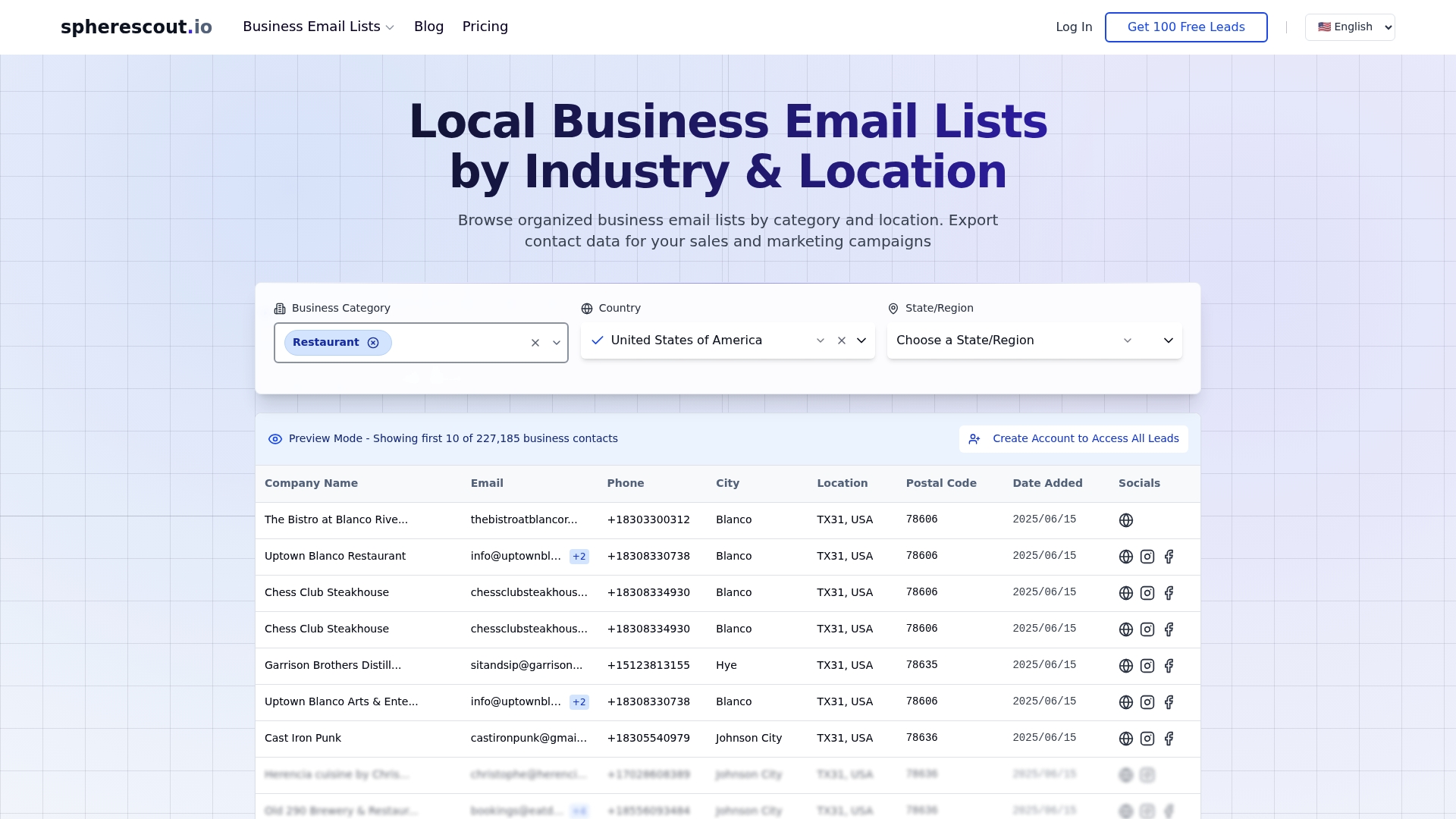
SphereScout.io gives B2B sales and marketing teams direct access to over 30 million verified business contacts, filterable by industry, location, company type, and more. That means you can build your ICP-aligned prospecting list in minutes, not hours. Whether you need business email lists for a focused email campaign or targeted segments for a full multi-channel sequence, SphereScout's export-ready CSV files plug straight into your CRM. You can even grab free sample leads to test fit before committing. If better data is what's standing between you and a stronger pipeline, explore lead generation for your market and start with a list that's actually worth working.
Frequently asked questions
What is a good reply rate for B2B cold email outreach?
A good cold email reply rate is 4 to 6%, while top-performing teams achieve 7% or higher, according to B2B outbound benchmarks. Most campaigns fall in the 1.9 to 3.4% average range, so even modest improvements in targeting and personalization can push you into "good" territory.
How many follow-ups should you send to maximize meetings booked?
Most deals close after 5 to 12 touchpoints, but 92% of reps stop before the fifth follow-up, missing significant opportunities. Building a structured cadence that goes beyond four touches is one of the highest-leverage changes a small sales team can make.
What's the most effective channel for initial B2B outreach?
Social media now generates the highest response rate at 42%, compared to cold email at 26%, making it the top performer for initial contact. HubSpot's sales research also identifies it as the leading source of high-quality leads for 35% of sales teams.
How can I improve the quality of leads in my B2B pipeline?
Tightening your ICP criteria, warming prospects before outreach, and running coordinated multi-channel sequences consistently improve pipeline quality. Demand-warmed prospects reply 2 to 3 times more often than fully cold contacts, which means better conversations and less wasted qualification time.
Do I need complex qualification frameworks for SMB sales?
Simple SPIN discovery paired with a practical qualification checklist outperforms heavy enterprise frameworks for lower-value deals. As sales methodology experts note, applying full MEDDPICC to low-ACV deals costs time and slows your sales motion without adding proportional value.
Recommended
- Email marketing strategies that drive real B2B results | spherescout.io Blog
- B2B Email Marketing Process for Lead Generation Success | spherescout.io Blog
- Master cold emailing: best practices for B2B success | spherescout.io Blog
- Boost lead generation with effective business list segmentation | spherescout.io Blog