

Most marketers assume email marketing compliance means slapping an unsubscribe link at the bottom of a newsletter and calling it done. That assumption gets businesses into serious trouble. What is email marketing compliance, really? It's a set of legal and operational obligations that govern how you collect, store, and use email addresses, what you say in your messages, and how you handle recipients who want out. These obligations span multiple laws across multiple countries, and getting them wrong can cost you far more than a few lost subscribers.
- What email marketing compliance actually means
- Technical requirements every compliant email must meet
- Common compliance pitfalls that derail campaigns
- Best practices for achieving ongoing compliance
- Managing legal liability with third parties
- My take: compliance is your competitive edge, not your constraint
- Start your campaigns on solid ground with Spherescout
- FAQ
Key Takeaways
| Point | Details |
|---|---|
| Compliance is multi-layered | It covers consent, content, identity, opt-out mechanics, and data security, not just unsubscribe links. |
| Laws vary by jurisdiction | CAN-SPAM, GDPR, and CASL have different consent models, so your obligations depend on where your recipients are. |
| Legal ≠ deliverable | Meeting legal standards does not guarantee inbox placement if recipients mark your emails as spam. |
| Third-party liability stays with you | Using an agency or purchased list does not transfer your legal responsibility for compliance. |
| Consent records are evidence | Document who consented, when, how, and what they agreed to, so you can defend your practices if challenged. |
What email marketing compliance actually means
Email marketing compliance is the practice of sending commercial emails in accordance with all applicable laws, regulations, and platform requirements. It is not a single rule. It's an ongoing operational standard that touches your list acquisition process, your email content, your sending infrastructure, and your response to opt-out requests.
The three laws that affect most U.S.-based marketers and businesses with international audiences are CAN-SPAM, GDPR, and CASL.
| Law | Jurisdiction | Consent model | Key requirement |
|---|---|---|---|
| CAN-SPAM | United States | Opt-out (no prior consent needed) | Honor opt-outs within 10 business days |
| GDPR | European Union | Opt-in (explicit, documented consent required) | Consent must be freely given, specific, and unambiguous |
| CASL | Canada | Opt-in (express or implied consent) | Implied consent has strict time limits |
The consent models are where most cross-border confusion happens. CAN-SPAM allows you to email someone without their prior permission as long as you give them a clear way out. GDPR flips that entirely. Under GDPR, you need documented opt-in consent before sending anything promotional. CASL sits in the middle, recognizing both express and implied consent, but implied consent expires after a set period.
Here's what all three laws share: they require accurate sender identification, no deceptive subject lines, and a visible mechanism for recipients to stop receiving your emails. Understanding email legality means recognizing that your obligations depend on where your recipients are located, not just where your business is registered.
- CAN-SPAM applies when you email anyone in the United States, regardless of where you operate.
- GDPR applies when you email EU residents, regardless of where your business is headquartered.
- CASL applies when you email recipients in Canada.
Operating in multiple markets means complying with all relevant frameworks simultaneously. That's not as complicated as it sounds, because meeting the strictest standard (GDPR) will generally satisfy the others by default.
Technical requirements every compliant email must meet
Compliance is partly about what your emails contain and partly about the mechanics behind your sending process. Both matter. Here's what every commercial email must include to meet email marketing legal requirements under CAN-SPAM, which serves as a solid baseline:
1. Accurate sender identity. Your "From" name and email address must truthfully identify who is sending the message. No fake names, no misleading domains.
2. Non-deceptive subject lines. Subject lines that misrepresent the email's content violate CAN-SPAM's core requirements. This includes clickbait that promises something the email doesn't deliver.
3. Clear advertisement disclosure. If the email is promotional, it must be clearly identified as an advertisement somewhere in the message.
4. Valid physical postal address. Every commercial email must include a physical mailing address. A P.O. Box is acceptable under CAN-SPAM. GDPR requires a registered business address.
5. Visible and functional unsubscribe mechanism. The opt-out link must work for at least 30 days after sending. You must honor opt-outs within 10 days of the request, though processing within two business days is considered best practice.
6. Suppression list enforcement. Once someone opts out, they go on your suppression list. That list must be honored across all future sends and by any third parties sending on your behalf.
7. Email authentication. Setting up SPF, DKIM, and DMARC records on your domain protects against spoofing and signals legitimacy to receiving mail servers. Authentication is not legally required under CAN-SPAM, but inbox providers increasingly treat unauthenticated mail as suspicious.
One distinction that trips up a lot of marketers: transactional emails versus commercial emails. Transactional emails are exempt from marketing consent laws because they serve a functional purpose, such as order confirmations, password resets, and shipping updates. The moment you add a discount code or product recommendation to that order confirmation, you've reclassified it as a commercial message subject to full compliance obligations.
Pro Tip: Build your transactional and promotional email templates in separate systems, or at minimum, maintain strict content rules that prevent promotional material from bleeding into transactional sends.
When you're building or auditing your sending process, read through Spherescout's guidance on structuring B2B outreach emails to understand how content decisions tie directly into compliance outcomes.
Common compliance pitfalls that derail campaigns
Most compliance failures are not the result of intentional rule-breaking. They come from informal processes and accumulated assumptions that nobody ever audited. Here are the most common ones:
- Using purchased lists without due diligence. Purchased email lists carry serious risks, including prior unsubscribes that were never honored, addresses obtained through illegal harvesting, and contacts who will mark you as spam immediately. Buying a list doesn't exempt you from your obligations.
- Assuming consent without records. "We always asked for permission" is not a legal defense. Certified consent records must document who consented, when, through what form, what language was shown, and what the recipient agreed to.
- Ignoring opt-out requests. Failing to remove someone after they unsubscribe is one of the most direct routes to an FTC complaint. This applies even when someone opts out directly in reply to an email rather than clicking the formal link.
- Mixing promotional content into transactional emails. As noted above, this voids the transactional exemption. It's a surprisingly common mistake when marketing teams start adding upsells to confirmation emails without realizing the legal consequence.
- Not monitoring third-party senders. If a marketing agency sends on your behalf, you are still legally responsible. The FTC is explicit: companies cannot contract away compliance responsibility to a third party.
- No approval workflow for email content. Without centralized review, content gets modified after approval, disclaimers get removed, or outdated claims go out. Each of these creates legal and reputational risk.
The consequences go beyond fines. Sending unsolicited email erodes your sender reputation with inbox providers. High complaint rates trigger spam filters that then suppress your entire domain, including emails going to opted-in contacts who actually want to hear from you.
Pro Tip: Run a quarterly suppression list audit. Cross-reference your active send list against all opt-outs, bounces, and complaint records. Even one batch send to a suppressed address can trigger scrutiny.

Best practices for achieving ongoing compliance
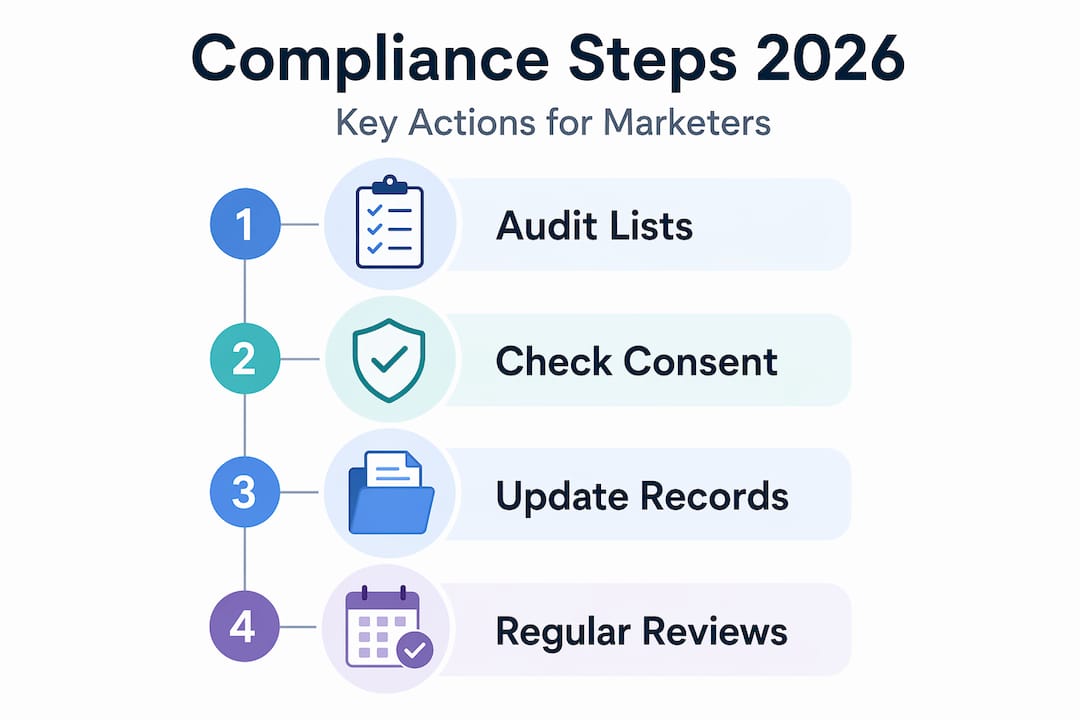
Getting compliant once is the easy part. Staying compliant as your team scales campaigns, hires new staff, and starts using new tools is where the work actually lives. Here's a framework for making compliance a built-in function rather than an afterthought.
1. Implement role-based permissions in your email platform. Not everyone on the marketing team needs send authority. Restricting who can launch campaigns reduces the risk of an unapproved email going out.
2. Capture and document consent at the point of collection. Every form, landing page, and lead capture mechanism should log a timestamp, the source URL, the consent language shown, and the user's IP address.
3. Automate opt-out and suppression processing. Manual opt-out handling is a liability. Automated approval workflows that integrate directly with your suppression lists remove the human error that causes most compliance incidents.
4. Build pre-approved content libraries. Legal and compliance teams review and approve templated copy, disclaimers, and subject line formulas in advance. Marketing uses those elements to build campaigns quickly without starting a new approval cycle every time.
5. Maintain a complete audit trail. Every send should log who approved it, when, what version was sent, and which list segments received it. This documentation is your defense if you're ever challenged.
| Compliance activity | Recommended frequency |
|---|---|
| Suppression list audit | Quarterly |
| Consent record review | Bi-annually |
| Email authentication check (SPF/DKIM/DMARC) | Annually or after domain changes |
| Third-party vendor compliance review | Annually |
| Content library refresh | Quarterly |
For a deeper look at how to build and manage this process end to end, Spherescout's email campaign workflow guide walks through approval and consent management in practical terms that work for B2B teams.
Managing legal liability with third parties
A huge portion of compliance risk in B2B marketing comes from third-party relationships: purchased lists, outsourced campaign management, partner co-marketing sends. The critical thing to understand is that your legal exposure doesn't shrink just because someone else touched the data.
- Vet your data sources before you buy. If you're acquiring contact lists, you need documented proof of how those addresses were collected, whether consent was obtained, and how recently the list was validated. Read Spherescout's breakdown of email list verification to understand what that due diligence looks like in practice.
- Put compliance requirements in writing with every vendor. Contracts with agencies, data brokers, and email service providers should specify who is responsible for suppression list integration, consent record maintenance, and opt-out processing.
- Integrate suppression files before any third-party send. If an agency is sending on your behalf, your suppression list must be applied to their send, not just yours.
- Audit third-party performance. Review complaint rates, bounce rates, and opt-out rates from any vendor-managed campaign. Unusual numbers signal data quality or consent problems that will eventually become your legal problem.
When considering whether to outsource any part of your email program, it's worth understanding that legal accountability does not transfer with the work order. You remain the responsible party in the eyes of the FTC and equivalent authorities in other jurisdictions.
My take: compliance is your competitive edge, not your constraint
I've watched a lot of marketing teams treat compliance as the department that slows things down. Legal review feels like a bottleneck. Consent requirements feel like friction in the funnel. I get it. But in my experience, every team that builds compliance upstream, before campaigns launch rather than after problems surface, ends up with a measurable advantage over those that don't.
Here's why. When your consent records are clean, your list quality is high. When your list quality is high, your engagement rates are high. When your engagement rates are high, inbox providers deliver more of your mail to the inbox instead of spam folders. Compliance and deliverability are not separate problems. They are the same problem viewed from different angles.
The teams I've seen scale email programs fastest are not the ones with the loosest processes. They're the ones that built a pre-approved content library, automated their suppression management, and locked down who can hit send. Compliance as a control layer actually speeds campaign launches because it removes the last-minute scramble to get legal sign-off on something that was never vetted.
Getting executive buy-in is easier than most marketing managers expect. Frame it in dollar terms. CAN-SPAM penalties can theoretically reach $51,744 per email in violation. A 10,000-email campaign with compliance failures has a theoretical maximum exposure in the hundreds of millions. You don't need that number to actually materialize to make the case for better processes. The risk itself is the argument.
— Raphael
Start your campaigns on solid ground with Spherescout
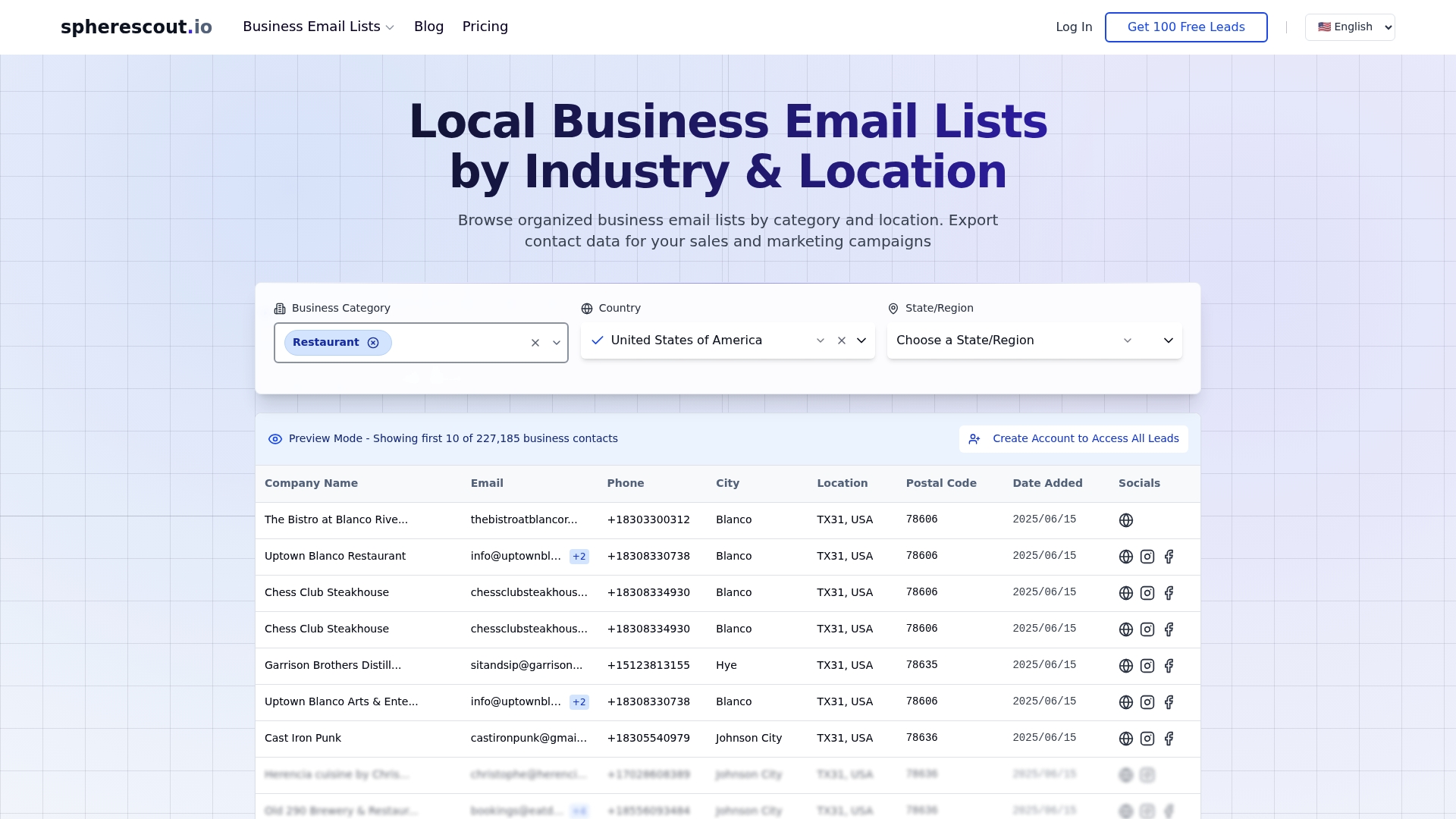
If the compliance framework above makes one thing clear, it's that list quality is where compliance starts. You can have perfect email templates, airtight suppression workflows, and full GDPR documentation, but if the contacts you're emailing were collected under questionable circumstances, your entire program is exposed.
Spherescout supplies B2B marketing teams with verified, industry-specific email lists built for professional outreach. The database covers over 30 million contacts across industries and geographic markets, filterable by category, city, and postal code. Every export is formatted for CRM integration and designed to support campaigns that meet current email marketing legal requirements. If you want contacts you can actually use without second-guessing the source, explore Spherescout's lead generation tools and see what a compliant prospecting workflow looks like in practice.
FAQ
What is email marketing compliance in simple terms?
Email marketing compliance means following all applicable laws and platform rules when sending commercial emails, including how you collect addresses, what your emails must contain, and how you process opt-out requests.
What are the main email compliance regulations?
The three most important are CAN-SPAM (United States), GDPR (European Union), and CASL (Canada). Each law has different consent requirements, but all require honest sender identification and a working unsubscribe mechanism.
Do I need permission before emailing someone?
It depends on where your recipient is located. CAN-SPAM allows emailing without prior consent but requires you to honor opt-outs. GDPR requires explicit opt-in consent before sending any promotional message to EU residents.
Can I use a purchased email list legally?
Purchased lists are legal under CAN-SPAM, but they carry significant risk. You must verify the source, apply your suppression list before sending, and document the list's provenance. High-risk list characteristics include unverified collection methods and lack of consent documentation.
How long do I have to process an unsubscribe request?
Under CAN-SPAM, you must stop sending to an opted-out address within 10 business days. Processing within two business days is considered best practice. Your opt-out mechanism must remain functional for at least 30 days after the email is sent.