

Phone numbers are not a relic of old-school sales. Despite the explosion of email automation and LinkedIn outreach, B2B teams still achieve 5-8% dial-to-meeting conversion rates when they pair verified contacts with sharp calling techniques. That gap between average and top-performing teams is not luck. It comes down to data quality, smart sequencing, and knowing exactly when to pick up the phone versus sending another email. This guide walks you through how to use phone numbers effectively, what the benchmarks actually look like, what compliance rules you cannot afford to ignore, and how to build a multi-channel strategy that converts.
- Measuring phone outreach success: What the data shows
- Data quality and phone number coverage: What really matters
- Compliance: Navigating TCPA, FCC, and DNC with B2B calls
- When should you emphasize phone vs. other B2B outreach channels?
- What most teams get wrong about phone-based B2B outreach
- Boost your B2B results with targeted, verified contact data
- Frequently asked questions
Key Takeaways
| Point | Details |
|---|---|
| Phone numbers amplify outreach | Direct calls paired with email lift response rates and campaign effectiveness in B2B. |
| Data quality trumps volume | Verified, targeted phone numbers outperform mass calling through better connect rates. |
| Compliance is critical | Always follow consent and DNC laws to avoid costly penalties when using phone numbers. |
| Choose the right channel | Blend phone and digital channels based on target segment, data quality, and buyer preference. |
How phone numbers fit into B2B outreach campaigns
Let's clear something up right away. Phone numbers are not a replacement for email, and email is not a replacement for phone. The teams that see real results treat both as parts of a coordinated sequence, not competing choices.
A typical multi-touch cadence looks like this: you send an initial email, follow up with a phone call, leave a voicemail if there's no answer, and close the loop with another targeted email. Each touchpoint reinforces the previous one. When someone hears your voicemail and then sees your follow-up email, the message lands differently than a cold email alone. That recognition effect is real, and it moves people from ignoring you to responding.
Here's why phone calls specifically add value in that sequence:
- Human connection: A real voice builds trust faster than text. Tone and delivery communicate things that words on a screen cannot.
- Immediate feedback: You learn instantly whether this is a good prospect. Objections, timing issues, and real interest all surface in minutes, not days.
- Voicemail personalization: A 20-second, personalized voicemail referencing a specific company challenge can dramatically boost email open rates.
- Course correction: If your messaging is off, a live call tells you immediately. Email analytics only tell you what happened, not why.
As part of a coordinated cadence, phone numbers work best when tracked in your CRM. Log every dial, every voicemail, every live conversation. This data tells you which steps in your sequence generate the most connects and meetings, so you can optimize rather than guess.
For teams just getting started with sequencing, reviewing solid cold email best practices is a smart move. And if you want to see how email and phone work together in practice, check out some high-response email examples that integrate well with phone-based follow-up.
| Channel | Strengths | Best used when |
|---|---|---|
| Phone | Human connection, fast feedback | Verified direct dials, high-value accounts |
| Scale, documentation, timing flexibility | Initial outreach, follow-ups | |
| Voicemail | Personalization, recall boost | No answer on live call |
| Relationship context, referrals | Warming up prospects pre-call |
Measuring phone outreach success: What the data shows
Here's where expectations often go sideways. A lot of sales reps assume cold calling simply does not work anymore, and they abandon it after a handful of unanswered dials. But the data tells a more nuanced story.
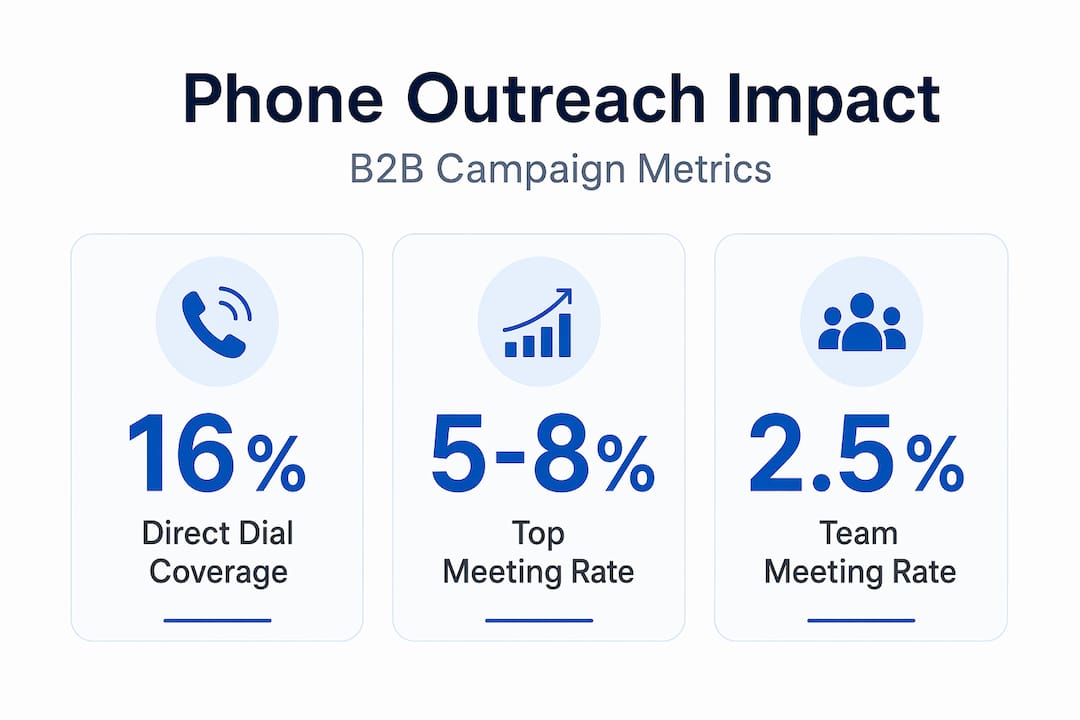
The average dial-to-meeting conversion rate sits around 2.5% across B2B teams. Top-performing teams, the ones with good data, disciplined sequencing, and active coaching, push that to 5-8%. That is not a trivial difference. If your team makes 200 dials per week, closing the gap from 2.5% to 5% means doubling your pipeline from the same effort.
What separates top performers from average ones? A few key factors:
1. Verified contact data: Calling numbers that are wrong, outdated, or unmapped to the right person wastes time and erodes morale. Investing in verified contact data is the single highest-ROI move for any calling program.
2. Segment targeting: VP-level and Director-level buyers tend to have better direct-dial coverage and higher decision-making authority. Starting with best-fit segments rather than blasting your entire list drives better connect rates.
3. Call timing: Calling Tuesday through Thursday between 8-9 AM or 4-6 PM local time consistently outperforms midday calls. Midday blocks have the lowest connect rates across most B2B industries.
4. Attempt frequency: Research consistently shows it takes 6-8 dials to reach a prospect. Most reps give up after 2-3. Persistence, within reason and with proper spacing, pays off.
5. CRM logging: Teams that track dial outcomes and iterate their sequences improve faster than teams that dial blind. Every logged result is a data point that shapes your next week.
Pro Tip: Don't start with volume dialing. Start by filtering your list down to your best-fit segments using firmographic data, like company size, industry, and job title, and prioritize those first. A smaller, better-targeted call list outperforms a massive, unfiltered one every time. Learn more about filtering business leads to build those segments effectively.
| Metric | Average team | Top-performing team |
|---|---|---|
| Dial-to-meeting rate | 2.5% | 5-8% |
| Dials per connect | 18-25 | 10-15 |
| Voicemail callback rate | 1-2% | 4-5% |
| Sequence steps before close | 5-6 | 8-10 |
Data quality and phone number coverage: What really matters
You cannot out-dial bad data. That is one of the clearest lessons from running calling programs at scale.

Here is a number that should get your attention: mid-market direct-dial fill rates can be as low as 16% with common enrichment providers. That means for every 100 mid-market contacts you pull, only 16 might have a usable direct-dial number. The rest hit switchboards, wrong extensions, or come back empty.
That is a serious problem for any team relying on a single data source.
Here is what smart teams do instead:
- Use multiple enrichment sources: No single provider has complete coverage. Layering sources, sometimes called waterfall enrichment, means running your contacts through one provider first, then filling gaps with a second or third source.
- Verify before you dial: Phone numbers change frequently. A verified number from six months ago may already be stale. Regular verification passes reduce wasted dials and protect your sender/caller reputation.
- Segment by coverage confidence: If you have high-confidence direct dials for one group and switchboard numbers for another, treat them differently. Build separate sequences with distinct talk tracks.
- Flag C-level contacts separately: C-suite contacts are notoriously hard to reach by direct dial. For those accounts, LinkedIn and email warm-up often work better as the primary channel, with phone as a secondary touchpoint.
📌 Coverage stat worth noting: A fill rate of just 16% means 84% of your dials are potentially wasted if you rely on one provider alone. Fixing your data pipeline is not an optional upgrade. It is a prerequisite for an effective calling program.
Pro Tip: Schedule a quarterly audit of your CRM's phone fields. Remove disconnected numbers, update contacts who have changed companies, and re-verify numbers that have been sitting untouched for more than 90 days. The process takes a few hours but saves hundreds of wasted dials.
Compliance: Navigating TCPA, FCC, and DNC with B2B calls
Here is the thing that a lot of B2B teams treat as an afterthought: regulatory compliance. It is not optional, and the fines are not trivial.
The Telephone Consumer Protection Act (TCPA) is the primary law governing outbound phone calls in the U.S. The FCC enforces it, and the penalties can reach $500 to $1,500 per violation for willful violations. If you are making thousands of calls per week without the right consent processes in place, the risk is real.
Here is what you need to know:
- Automated calls to cell phones require prior express written consent: If you are using an autodialer or playing a prerecorded message, you need documented consent before calling a cell phone. TCPA consent requirements are strict and actively enforced.
- Manual dialing has different rules: Human-initiated calls made without an autodialer carry fewer restrictions, but they are not exempt from all regulation. You still must respect DNC lists and opt-out requests.
- Do Not Call (DNC) lists apply: The National DNC Registry applies primarily to consumer numbers, but many business contacts are also registered. Scrubbing your list against DNC before a campaign is a baseline requirement.
- Honor opt-outs immediately: If someone asks to be removed from your calling list, that request must be honored within a reasonable timeframe. Ignoring opt-outs is a compliance failure, full stop.
"The TCPA's consent requirements for calls to cellular telephones are strict. A business that calls or texts a cell phone using regulated technology without the required consent faces exposure of $500 to $1,500 per call or text." This is not a legal gray zone. It is a business risk that needs to be managed proactively.
For teams building a compliance foundation, working with corporate compliance services that understand communication regulations is worth considering, especially if you are scaling your outbound volume significantly.
When should you emphasize phone vs. other B2B outreach channels?
Not every campaign warrants a heavy phone-call emphasis. Knowing when to lean in on calling and when to back off is a real competitive advantage.
Some teams shift toward email and LinkedIn when phone efficiency drops or compliance risks rise, particularly in regulated industries or when targeting audiences with strict communication preferences. Phone works best for high-fit, verified segments where you have direct-dial numbers and a compelling reason to call.
Here is a practical decision framework to guide your channel mix:
1. Do you have verified direct-dial numbers? If yes, phone is a viable primary channel. If no, start with email or LinkedIn to warm up the prospect first.
2. Is this a high-value account? Enterprise or key-account targets justify the additional time investment a phone call requires. Volume-targeted, low-ACV (annual contract value) accounts may not.
3. What is the regulatory environment? If you are targeting industries like healthcare or finance, where contacts may have specific communication expectations or restrictions, dial back your phone volume and lean on written channels.
4. Have you already emailed this prospect? A phone call is far more effective as a second or third touchpoint than as a cold opener, particularly for senior buyers who receive heavy inbound volumes.
5. What does your CRM data say about past connect rates for this segment? Let historical data drive the decision. If calls to this persona have consistently underperformed, shift resources to channels that work for that audience.
| Channel | Best scenario | Watch out for |
|---|---|---|
| Phone | High-fit, verified, high-value accounts | Compliance exposure, low coverage |
| Large volumes, initial outreach, follow-up | Deliverability, inbox competition | |
| Warm-up, referrals, relationship-building | Slow cycle, platform limitations | |
| Voicemail | Personalized recall boosts | Overuse causes ignoring |
Pairing phone with well-crafted email remains the strongest combination. Brushing up on cold emailing best practices alongside your phone strategy ensures both channels reinforce each other. For a deeper look at channel-specific results, the team's guide on B2B email strategies covers what actually moves the needle.
What most teams get wrong about phone-based B2B outreach
We have run a lot of outreach campaigns, and the pattern we see most often is the same across industries: teams conclude that "the phone doesn't work" after a low-return sprint, then abandon it entirely. That conclusion is almost always wrong.
The phone did not fail. The list did. Or the talk track was generic. Or the segment was a poor fit. The tool is not the problem.
The deeper mistake is treating phone numbers as a mass-blast resource instead of a precision asset. When a sales rep dials 150 random contacts per day with a recycled pitch, poor results are not surprising. But when a rep calls 30 carefully filtered, contact-verified prospects with a message tailored to their specific situation, the connect rate and meeting rate tell a completely different story.
Senior buyers, VP and C-suite contacts in particular, respond to targeted, well-researched outreach. They ignore noise. The difference between those two outcomes is the quality of your data and the relevance of your message. Compliance matters here too. A buyer who receives unwanted robocalls is not just unlikely to convert. They may report your number, tank your caller reputation, and permanently close that door.
The teams that get the most from phone outreach are not the ones dialing hardest. They are the ones calling smarter, with better data and tighter targeting.
Treat every verified direct-dial number in your database as a scarce asset worth protecting. Do not burn through your list with generic volume. Use it deliberately, with coordinated multi-touch sequences, personalized messaging, and regular data hygiene built into your process.
Boost your B2B results with targeted, verified contact data
Building a phone-based outreach strategy only works when your underlying contact data is solid. Inaccurate numbers, outdated records, and poor segment coverage are the fastest way to undercut even the best calling approach.
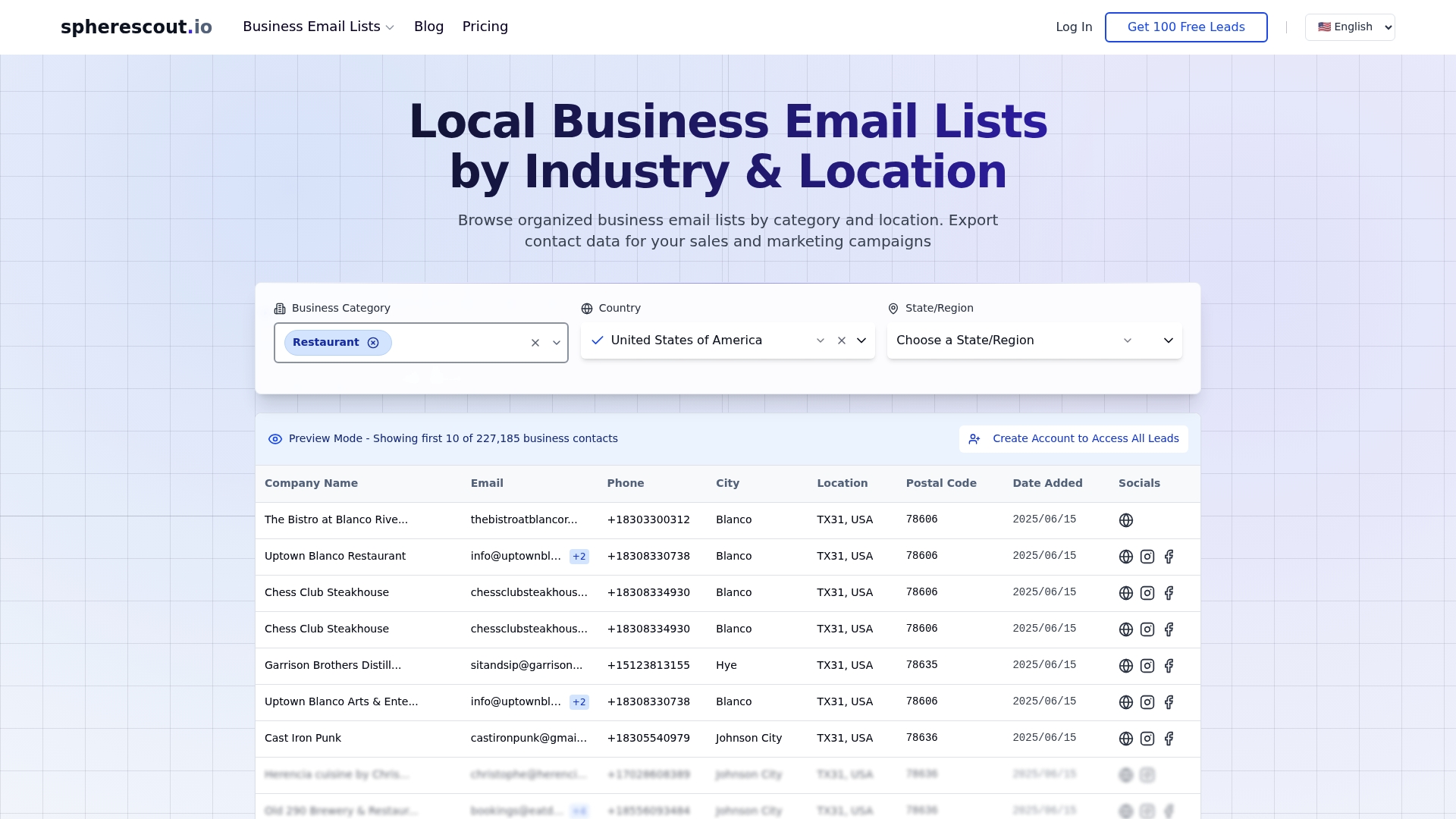
SphereScout.io gives B2B sales and marketing teams access to over 30 million verified business contacts, filterable by industry, location, job title, and more. Whether you need direct dials for a targeted VP-level calling campaign or complete contact records for a multi-channel outreach push, our platform lets you build, export, and deploy prospect lists in minutes. Explore our lead generation solutions to see how structured, accurate contact data changes your pipeline, or browse our business email list options to complement your phone strategy with verified email outreach.
Frequently asked questions
Why does phone number quality matter in B2B outreach?
Verified direct dials ensure your calls actually reach decision makers instead of hitting switchboards or dead numbers. As data shows, phone number verification directly impacts connect rates and the efficiency of your entire outreach pipeline.
How often should B2B teams update their phone number data?
Teams should verify and refresh phone numbers at least quarterly, and always before launching a major campaign, to avoid wasted dials and protect their caller reputation.
What happens if we use an autodialer to call cell phone numbers in the U.S.?
You must have prior express written consent before using an autodialer to contact cell phones. Calls using regulated technology without that consent expose your business to TCPA fines of $500 to $1,500 per call.
Are calls still effective compared to email or LinkedIn outreach?
Phone remains highly effective for well-targeted, high-value segments, especially when combined with email and LinkedIn. Conversion rates are highest when quality contact data and coordinated multi-channel sequences work together.
What's the typical meeting rate from cold calling in B2B?
The benchmark dial-to-meeting rate averages around 2.5%, while top-performing teams with strong data and optimized talk tracks can reach 5-8% through better targeting and coaching.
Recommended
- How to export contact lists efficiently for B2B outreach | spherescout.io Blog
- 7 High-Response Email Outreach Examples for B2B Teams | spherescout.io Blog
- B2B Email Marketing Process for Lead Generation Success | spherescout.io Blog
- Why verifying contact information boosts B2B leads | spherescout.io Blog